China’s Humanoid Race Is Really a Data Race. I Saw It in Shanghai
The robots get the headlines. The scarce input is the data that teaches them to act — and a slide at a Shanghai incubator made that clearer than any demo.
 By Sam Lundin ·
I spent about ten days in China, including Hong Kong. That included an executive education program in Shanghai and Shenzhen focused on AI strategy and humanoid robotics.
In Shanghai I visited a humanoid startup incubator, SenseTime, TiMi Robotics, and Westwell. I also sat in on an Alibaba Cloud session on large models, and visited SUNMI and iFLYTEK. Later in the week, in Shenzhen, I visited BYD, One Robotics, PaXini, Tencent, Meituan, and LAiPIC, among others. Very different businesses. What I came away thinking about is the same bottleneck: who has the data that teaches a machine to act.
I went to see the latest in Chinese technology and robotics: where they are, how it compares to the US, and to understand their culture. My one-line take on the visits: really cool.
A slide at a humanoid incubator in Shanghai made the data problem clearer than any demo. The open internet is mostly English, so language models have an English head start. There is no internet of robot actions. The companies that win this next race will be the ones with the most usable data on how to act in the physical world.
How little action data exists
My simple way to think about it: chat models learned from the internet. There is no internet of robot actions.
ACE Robotics, a company chaired by SenseTime co-founder Wang Xiaogang (ACE Robotics), put the problem bluntly to Computer Weekly: “The binding constraint for the humanoid and embodied AI industry today is data scale.” By its count the industry has accumulated only around 100,000 hours of manipulation data, against the tens of millions of hours it says the field needs (Computer Weekly).
Most of that data comes from teleoperation — a person steering a robot through a task while the system records. The company called that extremely inefficient, because every hour of footage ties up a robot and a trained operator (Computer Weekly).
That’s a supply problem. And Shanghai is attacking it from several directions at once.
The incubator, and a slide about language
The Shanghai Humanoid Robot Innovation Incubator sits in the Caohejing development zone in Xuhui district. The city calls it the first incubator in China focused on humanoid robots (Shanghai government).
Per a January 2025 notice from the zone, it was planned at about 12,000 square meters, with shared services including a 3D-printing rapid-response center, common robot testing, a robot “supermarket” and an AI Hacker House. The zone also set up a dedicated humanoid fund of about RMB 200 million for seed and angel rounds (Invest Shanghai).
The operator read: this is shared infrastructure that takes fixed cost off each startup. A young hardware company doesn’t have to build its own test rig or prototyping shop. That speeds up how fast new robot bodies show up — and every new body needs data to learn on.
That same morning, before the incubator visit, I heard a masterclass titled “Introduction to China’s AI Development Strategy and Governance,” by Dr. Tianjiao Jiang, a professor at the Development Institute of Fudan University.
One of the most striking parts of the incubator visit was a slide the presenter showed us. The slide listed languages, the share of people in the world who speak each one, and then the share of the web written in that language. As I remember it, it was something like this: English was spoken by about 15% of the world and accounted for about 60% of the language of the web. Chinese was also spoken by around 15% of the world, but had only about 5% of the web.
Those exact figures are what the slide showed, as I remember it. I haven’t independently audited them. Public trackers do show a large English skew in web content. As of November 1, 2026, W3Techs put English at 49.5% of websites whose content language it can identify, and Chinese at 1.2% (W3Techs history). The direction is the same. If anything, the Chinese share of the open web is even smaller than the slide suggested.
There’s a network effect, of course. The share of the web in a given language will obviously impact data, since models are trained on that information. There’s a self-reinforcing cycle. That’s a structural head start for English-language models.
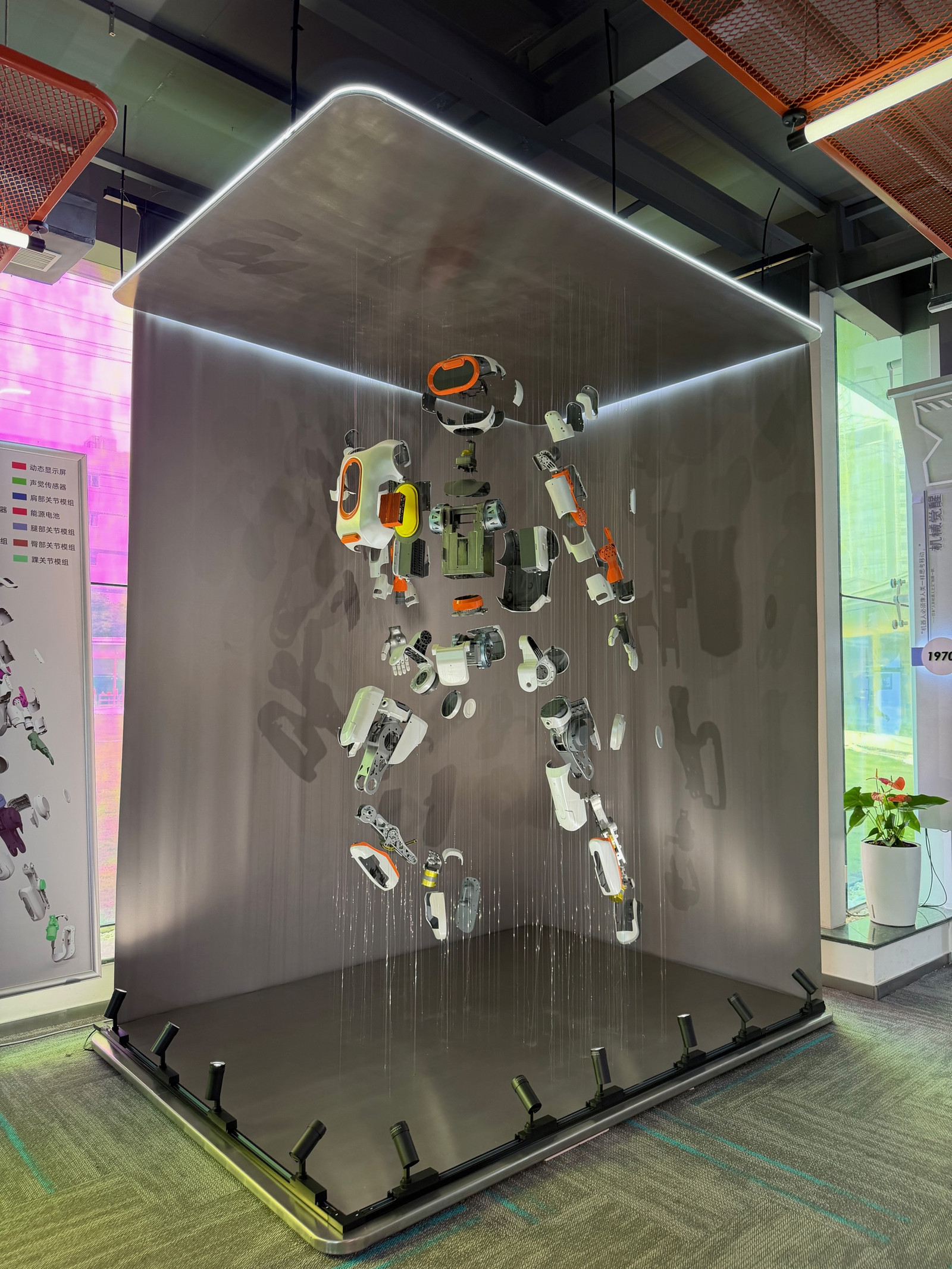
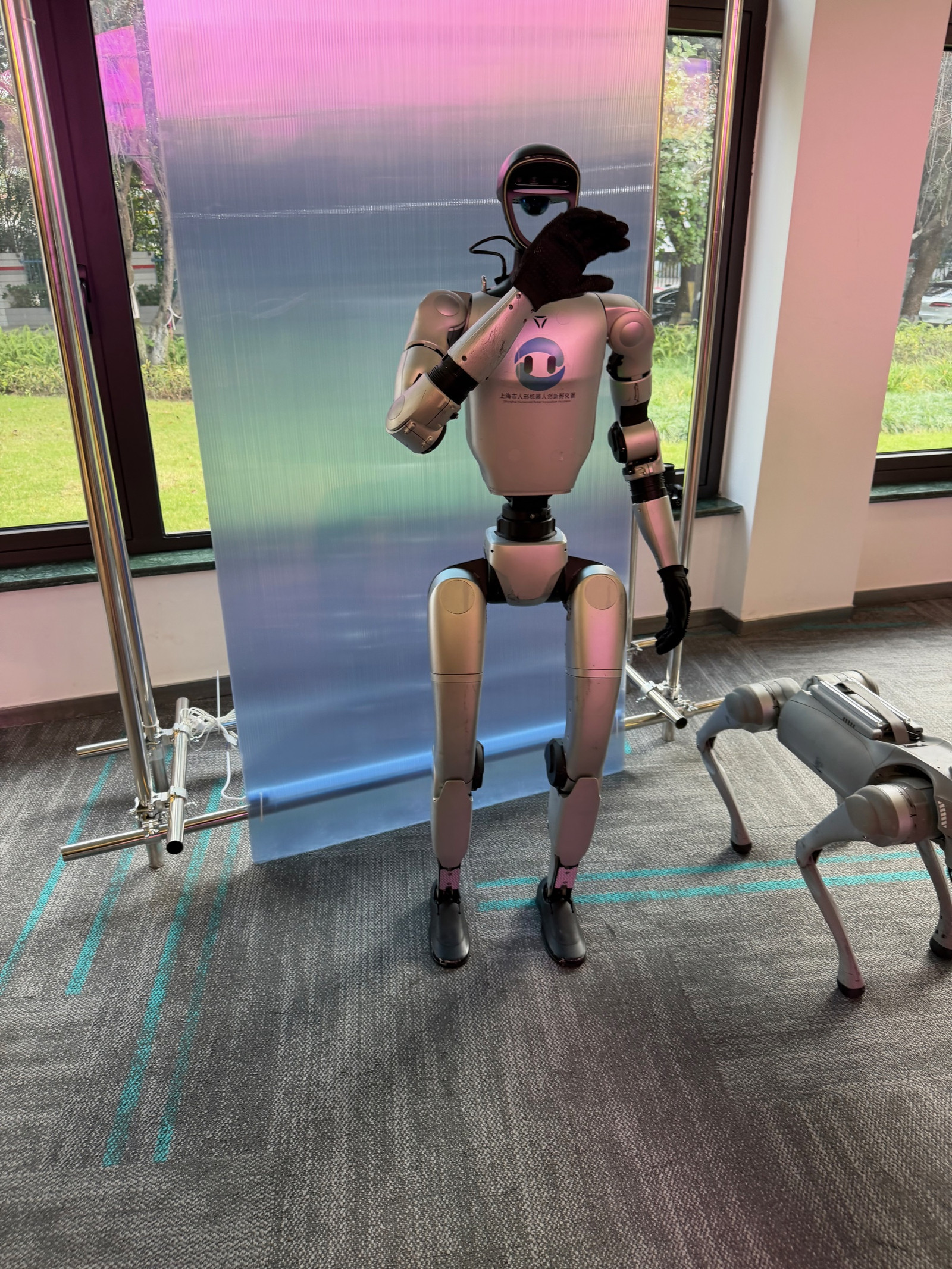
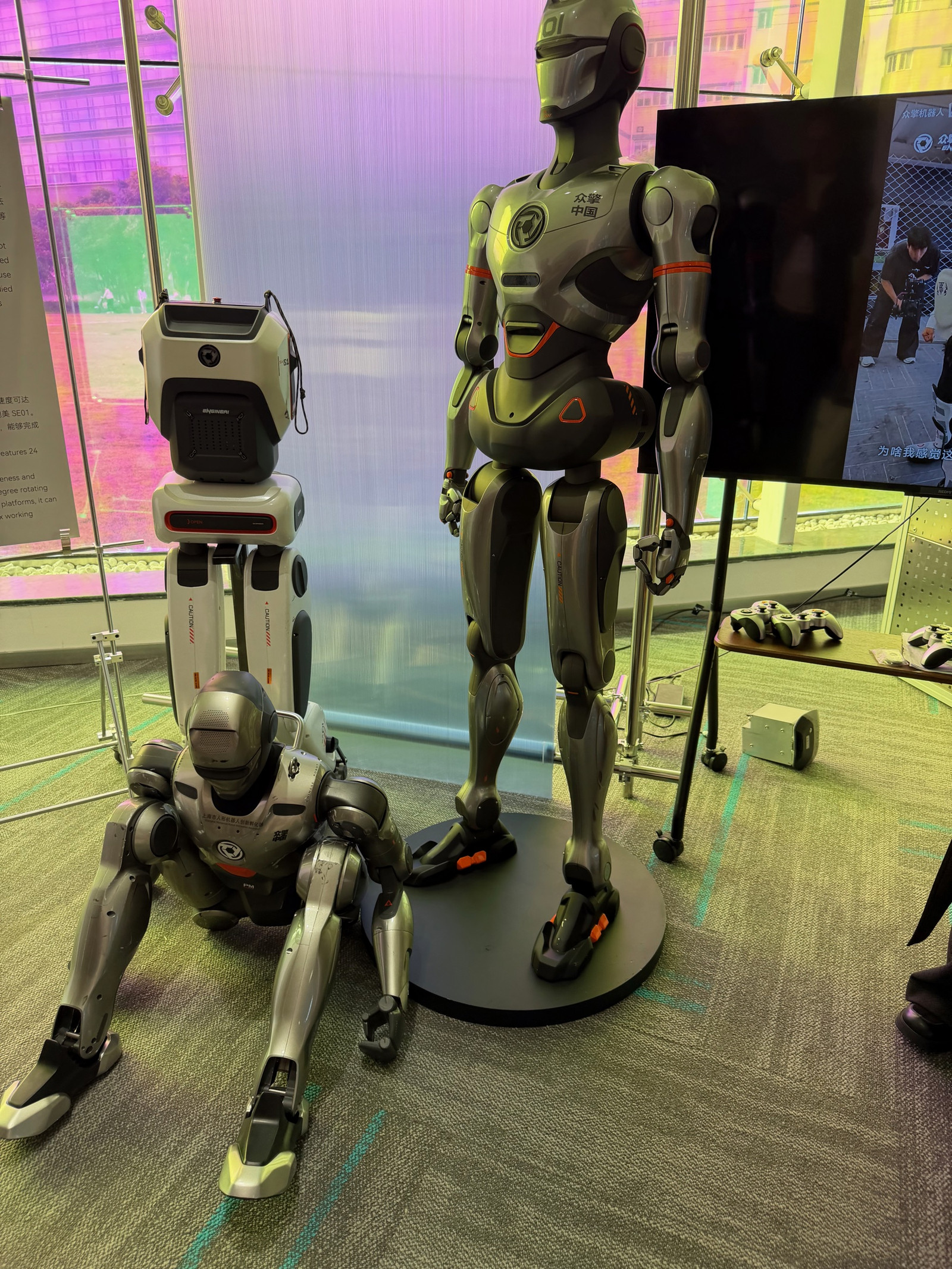

That’s the language-model race. Chat models learned from the internet, and English got there first. There is no equivalent corpus of robot actions. The rest of what I saw in Shanghai is an attempt to build that layer for the physical world.
Robots already at work
The data problem looks different once the robots are out of the lab.
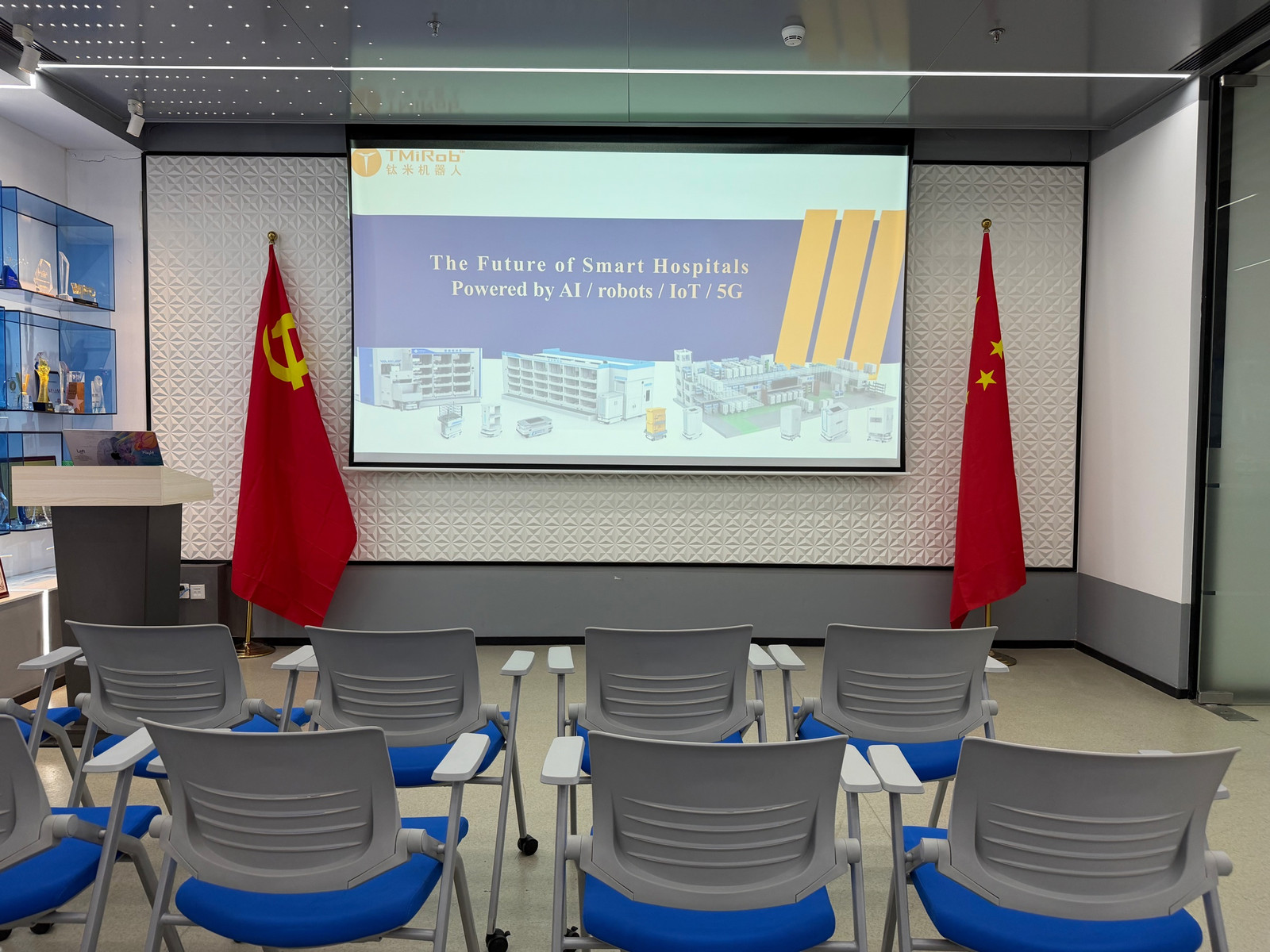
The next morning I visited TiMi Robotics. (That’s the agenda’s spelling. The company brands itself TMI Robotics, or TMiRob.) The agenda described it as a healthcare-robot company working on infection control, flexible logistics, and clinical services. Per its own about page, as of January 2026 its systems were in use in more than 700 large tertiary hospitals across 28 provinces, plus some private hospitals (TMI Robotics). The same page describes disinfection robots, in-hospital delivery of supplies, controlled drugs and waste, and clinical-service robots.
The same afternoon I visited Westwell, which automates ports; I wrote that visit up in The Robots Already Working in China Don’t Have Legs.
Later in the week, in Shenzhen, I visited PaXini, whose tactile-hand work I wrote up in Touch Is the Bottleneck.
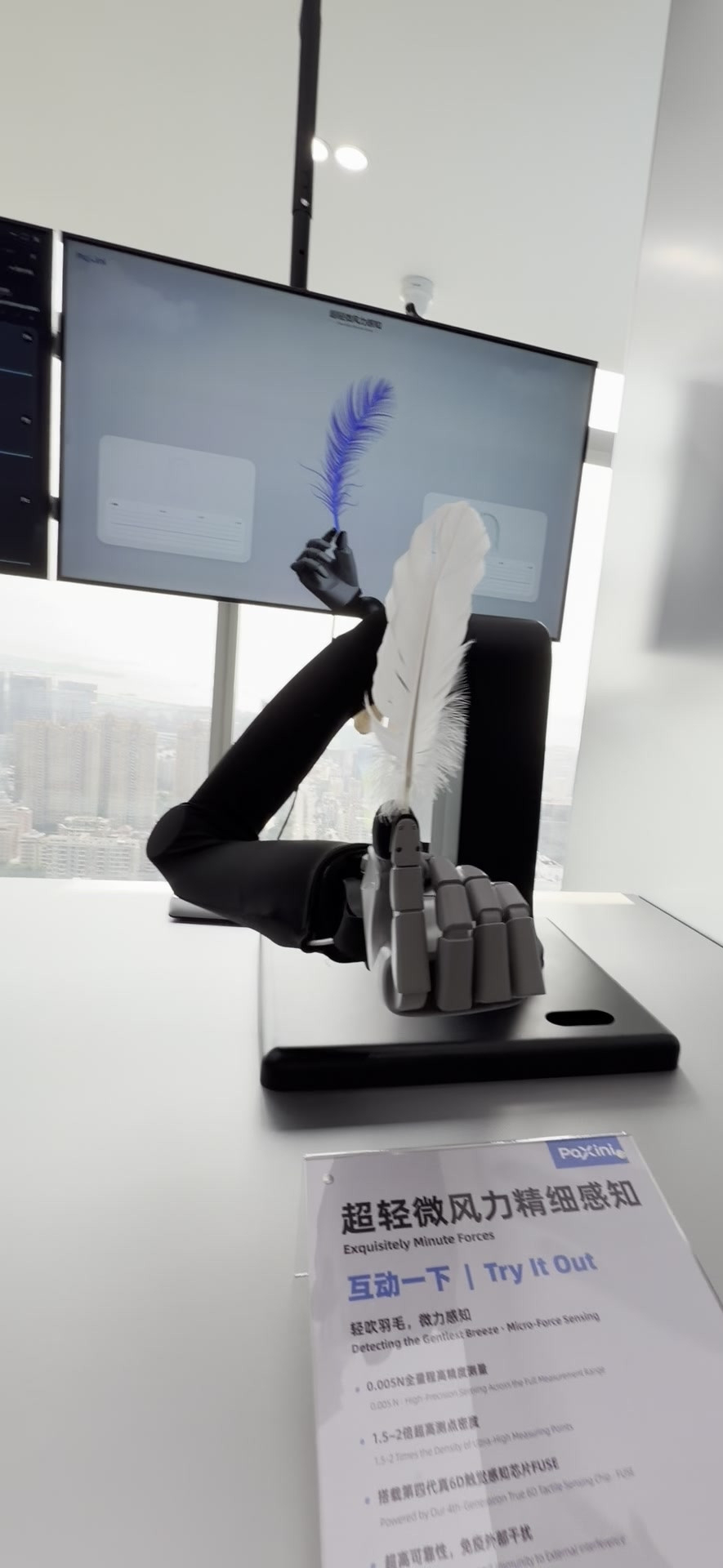
I also visited Meituan, whose drone-to-kiosk delivery I wrote up in the same robots-without-legs piece.
SenseTime, and recording people at work
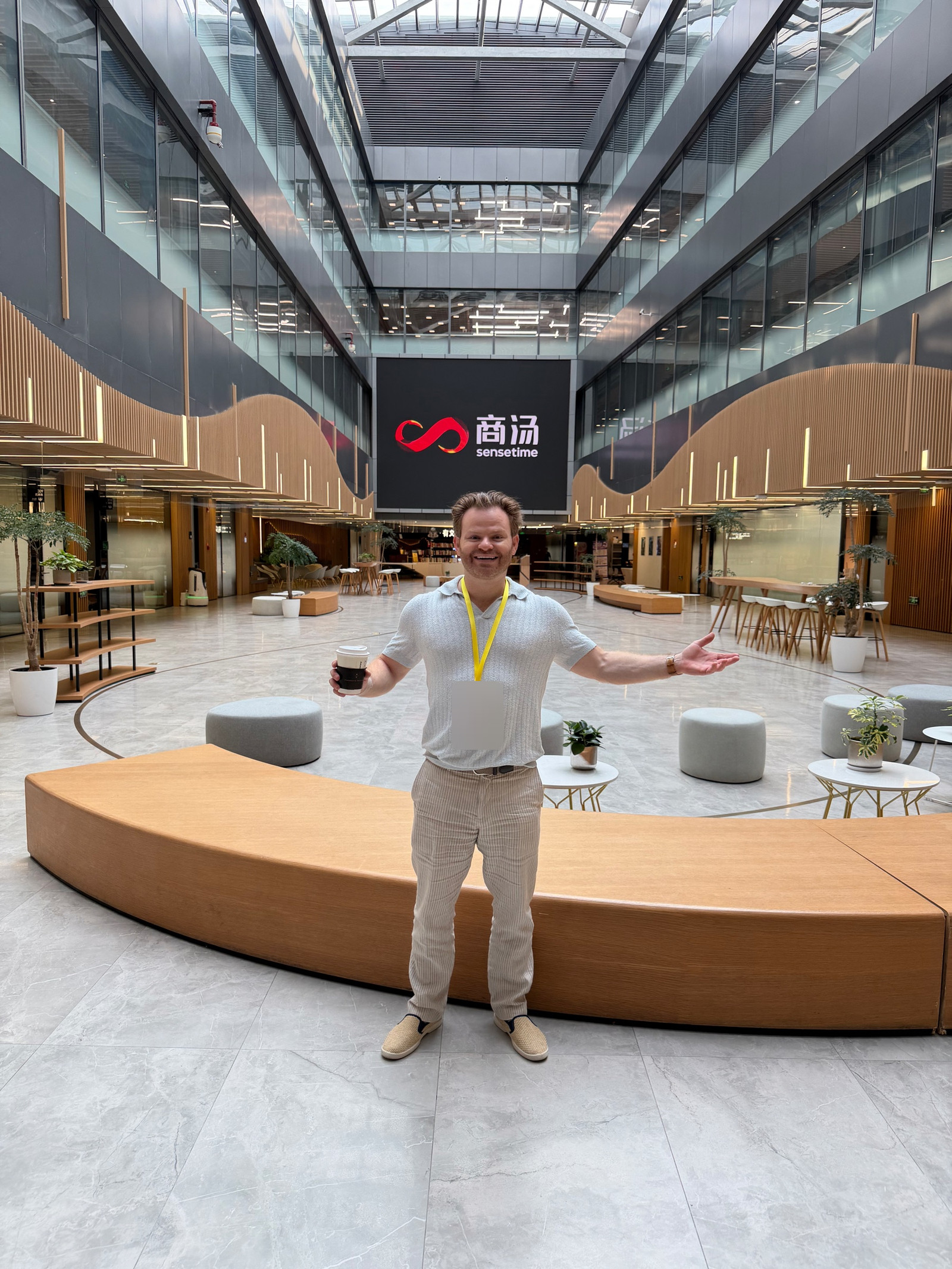
I visited SenseTime, which the agenda describes as an AI company focused on computer vision and large models. SenseTime had a robot that served drinks for us. You could buy from the cash register and the robot would get it for you. That was kind of cool.
On the public record, SenseTime’s co-founder Wang Xiaogang chairs ACE Robotics, which SenseTime’s investment arm backs (SenseCapital; Computer Weekly).
ACE’s answer to the data shortage is to skip the robot entirely during collection. It records people doing real work in kitchens, warehouses and other sites, using a headset with cameras, tactile gloves and a motion-capture suit. Its claim: “A thousand people wearing our devices can generate 10,000 hours of real-world data in a single day” (Computer Weekly).
Its world model, Kairos, runs on the robot rather than in a data center, at four billion parameters. One system picks, packs and restocks orders at Alibaba’s Taobao Instant Commerce warehouse in Hangzhou (Computer Weekly). To its credit, the company doesn’t claim it has solved open, unstructured environments — it calls that “the extreme long tail.”
On the same day as SenseTime I also sat in on a session titled “Alibaba Cloud and Large Models,” with Gao Junjie, VP of Strategic Development at Alibaba Cloud; Gu Jun, Director and Head of the Demand Center for International Marketing Growth at Alibaba Cloud; Chen Juyi, Global Marketing Head of QwenWork; and Wang Yu, Director of Strategic Development at Alibaba Cloud. I later visited SUNMI, which makes commercial IoT devices, and iFLYTEK Shanghai, a speech-and-language company.
Tencent’s work tool, and another kind of race
At Tencent I watched a presenter run their work tool, Work Buddy, on Claude Sonnet; I wrote that visit up in I Watched Tencent Demo Work Buddy on Claude Sonnet. On foundation models, they were using American technology. On robot data, Shanghai is organizing at scale. Those are two different races.
Data compilers I didn’t visit
I did not visit a specialist “data compiler” on this trip. That layer still matters, because it is the most direct expression of the thesis, so I want to flag it from the public record.
A Shanghai company called ArcheBase puts it this way on its website: “Robots need operational data, not just observational data.” Observational data records what happened — images, trajectories, logs. Operational data captures “the actions, states, contact, and failures that make robot learning possible” (ArcheBase).
In an April interview with TMTPost (in Chinese; my paraphrase), the founders said the scarce thing in the industry is no longer how much raw data you collect, but the ability to turn messy physical-world signals into training material a robot can actually use (TMTPost).
They describe a five-step pipeline: quality-check incoming data, align it in time and space, “compile” it into task-level features, make it searchable, then package it for customers (TMTPost). One example from the interview makes the alignment problem concrete. A camera might record at 30 Hz, an IMU at 500 Hz, and the robot’s joints at yet another rate. Until those streams share one clock and one coordinate system, you can’t really train on them.
Two details from that interview stood out to me as an investor:
- Four embodied-AI companies — Lingchu, Qiongche, AI² Robotics (智平方) and Zhejiang Humanoid — put in an angel round of tens of millions of RMB and became its first customers (TMTPost). When your investors are also your customers, that’s a demand signal.
- The plan is a real-robot data-collection factory of more than 10,000 square meters, with 400+ robots across 10+ hardware types (TMTPost). That’s a plan, not a facility I can confirm exists today, and not something I saw.
(I think of this layer the way I think about our own supply chain. The factory gets the attention, but the spec sheet and the QC process are what decide whether the product works.)
Official coordination
Here’s the part that’s easy to miss from the US. The coordination isn’t just company by company.
In June, the national-local co-built humanoid robot innovation center in Shanghai’s Zhangjiang area launched what it called China’s first alliance for first-person, real-scene embodied-AI data. Members include ACE Robotics (大晓机器人) and Qiongche. The stated goals: shared collection, labeling, cleaning, ownership and data-exchange standards across factories, city services and warehousing (Shanghai enterprise platform).
The same notice says the center has led or joined work on more than 80 standards, and that seven interconnected humanoid training bases now operate nationwide (Shanghai enterprise platform).
Data standards are unglamorous, and they are also how you get an industry to pool what no single company can afford to collect alone.
That same afternoon in Changning, after Westwell, I heard Xu Qi, Deputy Secretary-General of the Shanghai AI Industry Association, give a talk titled “Shanghai AI Industry: Development Direction and Future Trends,” following welcome remarks from a leader of the Changning District Government. In Shenzhen I also heard Jianfeng Cao, an associate professor at Shenzhen University Law School, give a masterclass titled “Shenzhen Robotics & Startup Ecosystem.”
What I’d ask next
If you’re buying robots, ask the vendor about data before you ask about price. How many hours of real task data is the model trained on? Where did it come from — teleoperation, simulation, people wearing sensors, or robots already working in live sites? Do they capture failures and recoveries, or just successes?
If you’re investing, the data layer may be the better business than the bodies. Pipelines and data factories can sell to every robot maker. That’s one reading of why, on the public record, four robot companies backed ArcheBase. Hands may be another: PaXini looks to me like a company that wants to sell its technology to other robot manufacturers, not to the public.
If you’re in the US, the language-model race still has an English, and American, head start — I watched a Tencent presenter run their own work tool on Claude Sonnet. The robot-data race, and port automation, look different. We are behind on the latter, and I really need to see American frontier robotics technology, not just Chinese.
I’m unclear how fast human-recorded data really transfers to robots. That’s the bet ACE is making, and it’s unproven at scale. If wearable-captured data turns out not to transfer, the advantage swings back to whoever has the most robots deployed in real sites.
If you run a warehouse or a plant, would you let a vendor record your people’s work to train its robots? On what terms?
Disclosure: This was an executive education program trip. No company reviewed this piece. I hold no positions in any company mentioned. My own consumer brands are manufactured in China.
Sources & notes
- Computer Weekly, “ACE Robotics takes aim at embodied AI’s data problem,” Aug 17, 2026: https://www.computerweekly.com/news/366649472/ACE-Robotics-takes-aim-at-embodied-AIs-data-problem
- ACE Robotics, About Us: https://www.acerobotics.com/en/about
- SenseCapital (SenseTime’s investment arm) portfolio page, 大晓机器人 / ACE Robotics: https://www.sensecapital.com/portfolio/73
- Invest Shanghai (from 科创漕河泾), Jan 26, 2025, in Chinese: https://www.investsh.org.cn/cn/investsh/ywjqs/2025012614551775724101
- Shanghai Municipal Government, May 1, 2026: https://english.shanghai.gov.cn/en-Latest-WhatsNew/20260501/18939c5d98d34b85a1a119cd1b9391d6.html
- W3Techs, history of content languages for websites, as of November 1, 2026: English 49.5%, Chinese 1.2% of sites with a known content language: https://w3techs.com/technologies/history_overview/content_language
- TMI Robotics (TMiRob) about page, in Chinese, company figure of 700+ tertiary hospitals as of January 2026: http://tmirob.com/abouts
- Westwell, Q-Truck fleet at Hong Kong International Terminals, Apr 2026: https://en.westwell-lab.com/resources/News/299
- ArcheBase website (sourced background only; I did not visit): https://archebase.ai/
- TMTPost / ZhiKer, Apr 17, 2026, in Chinese (paraphrased; sourced background only). The company has three founders — Yang Zhexuan, Xu Liangwei and Zhang Jiye; the published interview is with Yang and Xu: https://www.tmtpost.com/7956994.html
- Shanghai enterprise service platform (Zhangjiang AI Innovation Town), Jun 23, 2026, in Chinese: https://desk.sh.gov.cn/pdfpt/gzdt/20260624/5ec5390cf8cb4ee7829fa5620551517a.html
- First-hand, from the program’s final agenda and my trip notes: visits to the Shanghai Humanoid Robot Innovation Incubator, SenseTime, TiMi Robotics and Westwell, plus an Alibaba Cloud session, SUNMI and iFLYTEK Shanghai, in Shanghai, Nov 2026; BYD, One Robotics, PaXini, Tencent, Meituan and LAiPIC in Shenzhen, Nov 2026. Tencent was the evening of Thu Nov 5. BYD (Nov 4) is mentioned as a visit only; I have not written impressions of it. At SenseTime, a robot served drinks from a cash register. ArcheBase was not on the final agenda and was not visited. The incubator language/web figures are what the presenter showed, as I remember them, not an independent audit.